Showing posts with label sage grouse.. Show all posts

Friday, May 2, 2014

Leucistic Robin and other birds

I got a call from a lady that told me her daughter had a strange robin in her year.  I went visiting and found the robin, common Grackle and some Yellow-rumped warblers.  It was a fun hour.  Here the leucistic robin harvests a worm for the lawn

Yellow-rumped warblers were every where; in the trees, on the rocks, on the lawn and on the road.


The day before I found these two male turkeys chasing two females near the Henrys Fork of the Snake River.


Last Saturday I caught some sage grouse displaying on the top of a ridge.  I am visiting that same place tomorrow morning with a friend.


Just a few days in the Wilds of Idaho.

Sunday, May 8, 2011

Wildlife in the rain

For the last two days, rain has dominated the weather.  It is tough getting good pictures in the over-cast sky when the clouds are crying.  It almost makes me cry when I am trying to get some good pictures.

But across the desert and marshes I traveled.  First to the Sage Grouse lek where only the males showed up - females are nesting and males are staying available for a female that might lose its nest.


As I headed across the desert looking for new Sharp-tailed grouse leks, I found pockets of blooming Buttercups.


I also saw nine herds of elk moving from their wintering grounds to the areas for them to calve.  Many will return to Yellowstone Park about 80 miles away.


As my raptor nest study will begin next week, I started by trying to locate nests.  Three Swainson's Hawk nests were found.  But they have not started sitting on them.


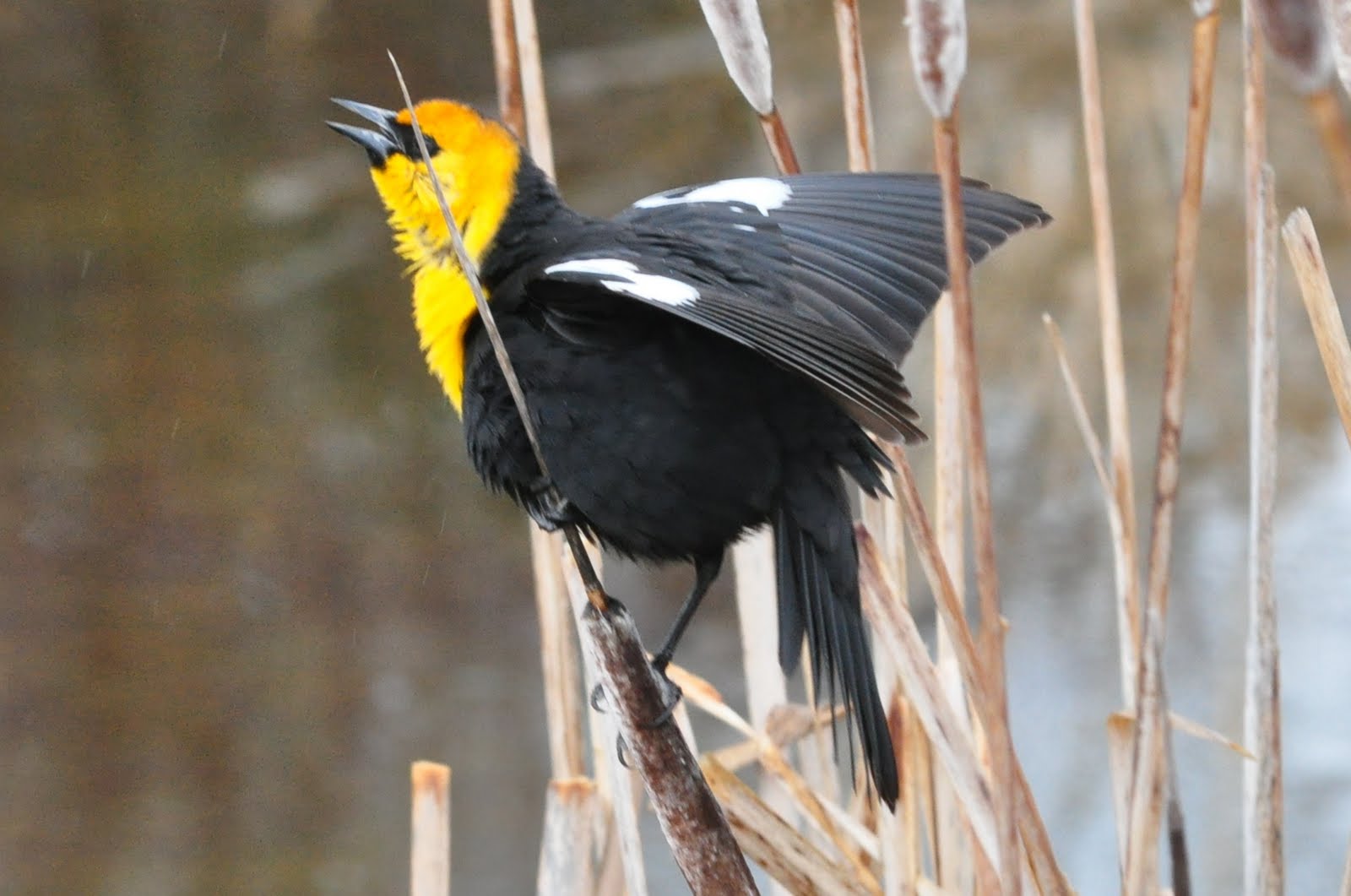
Then today on the way home from Church, I watched the male Yellow-headed Blackbirds, staking out their territory and inviting the females to come to visit them.  There was a little flirting going on, but all the females have not yet returned.  Give them another week. 


Even the rain could not totally dampen the beauties in the Wilds of Idaho.

Sunday, May 1, 2011

Lobsters are for the birds

The Common Loons, all 22 of them were feasting on Rocky Mountain lobster - crayfish, crawdads, whatever you want to call them.  They were so fun to watch them with their lunch.  Common Loons are not so common here, but right now they are migrating through and they are a sight to see and their mournful cry that we usually only here in mountain lakes around Yellowstone Park.


Saturday was one of those birding days you dream about - start early, end late and during the middle of the day you mow the lawn with snow hiding under the bushes and trees.  Maybe not mowing the lawn with snow falling - but it needed to be done.  But the birding on both ends of the day was superb.  With 56 species indentified and some pictured for the first time.  But the day started out visiting the birds that got me into birding - the Greater Sage grouse.  These  eight pound birds trying to attract the ladies.  Here one puffs out his chest just as the sun came up.


One of the special birds was a Ruby-crowned Kinglet that I photographed for the first time.  What a beautiful bird that flitters through the willows, making it difficult for me to catch.


One of the spring birds I love to watch are the beautiful Eared Grebes.  There are about 30 on one pond where I have set up my blind. They are a lot of fun.


What a great day as I spent over eight hours out in the wilds of Idaho.

Saturday, April 23, 2011

Yellow-throated Warbler and Sage Grouse

A rare bird gets me very excited and yesterday a friend called to tell me a Yellow-throated Warbler was at the Ashton Fish Hatchery.  Having never seen one and with only three recorded in Idaho history, I was after it.  But that was not possible until the sun warmed up the 10 degree weather.  So out to watch the Sage Grouse do their dance and breeding.  Here is a series of pictures of their display.

Here one of over 100 males is displaying on a road.  He stands at attentions and takes a deep breath.


Here he raises up taking a deeper breath.


His wings rub on his exposed chest making a squeaking sounds as he continues to suck in air.


Dropping his wings he sucks in more air.  The deepest of all the intakes of air.


Now he starts to full the two large air-sacks on his chest.


The air that has filled his lungs is now transferred to the air sacks.


To completely fill the sacks, he buries his head between the air sacks.  Notice the blood vessels running through the membrane of the air sacks.


He then releases the air and stands at attention to see if any of the ladies were impressed enough to visit him.


This is a dangerous place for these endangered birds to flirt and breed.  It is a good thing that this road is usually only traveled by farmers and bird watchers, or many would be killed.


Here is a poor quality of a lifer for me.  Not good but the best I could do today.


A Yellow-throated warbler to end another exciting day in the wilds of Idaho.

Saturday, March 19, 2011

Big birding day.

This morning I left the house at 6:30 with two goals - find the snow geese and see if I can find some sage grouse.  The roads out to the sage grouse leks are still blocked but as I pulled into Camas National Wildlife Refuge three grouse were flying over the pond.
The ponds are filling with water, but the snow geese have not found it yet.  The trumpeter swan and pintails have.


Did not find any snow geese at the refuge, so I headed for Mud Lake.  This Red-tailed hawk was hunting in a field where about half of the snow was gone.


About two mile east of Mud Lake I finally found the snow geese.  There were not a lot of them, but they were a sight for sore eyes.  They were coming in on small waves.


One group had a White-fronted goose with them.  It is only the third one I seen.

At Mud Lake I found this nesting in a bunch of Russian olives. 

For my last stop I headed to Market Lake.  It was still ice covered, but west of the freeway the fields were flooded by melting snow and covered with migrating Northern Pintails, Widgeon, Mallards and Northern Shovelers.

Nine hours of birding produced 49 species of birds and seven species of animals.  A great way to spend a wild day in Idaho.

Saturday, April 10, 2010

Sage Grouse Lek

Great morning.  I got to the sage grouse lek at 5:15 this morning and 10 minutes later the grouse started arriving.  First the males with their flowing white collars and then while it was still dark the cackling hens arrived.  The hens that were ready to be bred arrived first.  I did get four poor pictures with the aid of my flash to get some breeding pictures.  Here is one of them.  This cock bred six of the seven hens I witnessed being bred.   Data says that 10 per cent of the cocks do 90% of the breeding.
 

As it got lighter,  I started getting pictures of the displaying males around me.  Here is a non-breeder just east of me as the sun rose, the sun lighting up his fanned tail feathers.


The dominant cock of the lek was surrounded by 11 hens after the sun came up.  Here he is with three of them.  None of them squatted and spread her wings indicating a willingness to be bred.


I thought this hen would eventually welcome his advances while the sun was shining, but it would not happen.  All of his displaying was wasted.


After all the hens wandered off into the sagebrush, the dominant male displayed for 30 minutes trying to entice them back to the lek.  Here is a series of his display.  First he sucks in a big breath of air.


Then he puffs out his chest air sacks a little.


He then rubs his wings on his chest making a squeaking sound as he takes in a huge breath of air.  Notice his mouth is wide open and he has extended his body and legs to allow the greatest intake of air.  From the side view, he would be leaning backward.


Next he brings his head down, burying it in his white collar, forcing all the air into his air sacks, pushing them out and making a loud "plopping" sound.


With the air sacks being stretched to the limit, they show wrinkles as the air escapes.


With 30 to 40 males displaying on one lek, it can be very intertaining and a wonderful way to spend a few hours watching another wild day in Idaho dawn.  I was back home by 8:15 in time to do yard work.

Sorry this was so long - could have been longer, but this will suffice.

Sunday, April 4, 2010

Snow, Snow, snow

Three days of snow slowed the birding during my Spring break, but did not stop it.  I encountered some old and new birds.

Between snow storms I located the Long-eared owl nest without disturbing the female.


While the male circled and kept an eye on me.


The snow started to fall on Thursday after I left the owls and the sandhill cranes, teal and coots did not seem to mind.


But then on Friday, the ground was covered and I slipped out at 5 a.m. to see if I could find my first Sage grouse of the season.  I found them on a lek, but only seven males and no females showed up.  I was able to get a few pictures, but they did not stay long as they preferred the sage rather than the bare snow covered breeding ground with no breeding to be done.


With snow showers and wind up to 40 mph, the ice on Mud Lake started to break up exposing winter-killed fish.  On the edge of the ice 54 eagles, mostly immature Balds, gathered to feed.  That evening, I hid in some large cottonwood trees and photographed the eagles coming into roost.  The grey skies did not make for great shots, but it was exciting to watch these birds fight the wind to find their roost for the night.


Even in the snow, it was a great way to spend two days in the wildness of Idaho.  Happy Easter.

Sunday, November 8, 2009

Sage grouse

I have been gone to Utah to a leadership conference with my Student Body Officers. It was a great experience and the kids were absolutely great - all 20 of them.

While in the motel, I read an article about how barbed wire fences are harmful to the Great Sage Grouse and this may place them on the endangered species list. Rather interesting as this will be the thousandth time this has been attempted. Last spring a group tried to outlaw photographers from visiting the leks (breeding grounds) where the grouse congregate each spring. These leks have been used for hundreds of years.  The group said we were disturbing the breeding of the grouse. It is a long story so I will write about that later. But here is proof that when the sex bug bites - who cares if a truck is within eight feet of you.

Meet Whitey - the dominate male of a lek I love to visit. He has been the dominate cock on the lek for the past three years and probably breeds 50 per cent of the hens that visit.  This leaves a lot of jeolous males mad at him. I named him for the white feathers on his left side.


I have seen him surrounded by as many as eight hens waiting to be bred while they ignore the other displaying males.  Here a hen squats, informing Whitey she is ready to be bred.


Whitey mounts her not eight feet from my truck as my camera continues clicking.


As he completes the breeding he is attack by a jeolous male.  I can imagine what is being said, "Who do you think you are?  Warren Jeffs!!!"  as this is the third hen bred that morning by Whitey.


The hen is not very lucky, as she is trapped under the battling males and limps off after escaping from them.


Not two minutes later Whitey is surrounded by four other females, all desiring to be bred by him.


He breeds his fourth hen of the morning just as the sun comes up and the last one as the lek is attack by a pair of golden eagles that flushes them.  There were 27 males and 14 females on the lek that morning.


Hopefully I will be able to visit the leks next spring to get a few more pictures before that activity is outlawed.  I only have about 40,000 pictures of sage grouse, but not the perfect one yet.

Hoping for more wild days in Idaho with the sage grouse.