Showing posts with label Henrys Fork of the Snake River. Show all posts

Saturday, January 10, 2015

Belted Kingfisher in action

Had some great days this week watching and photographing wildlife throughout Southeastern Idaho.  On Thursday I decided to target some Belted kingfishers that I had observed two days in a row, so I set up near one of their favorite perching spots.  It was an old cement pillar to hold an irrigation pipe.  I wasn't long before one showed up.
 
It finally located a food item near the edge of the water.

 
As it emerged out of the water, I noticed it had a successful dive.


It looked like a stonefly nymph as it twisted and turned it around looking for the best way to eat it.
 
 
Several times it tossed the victim in the air, catching it each time.

 
After it swallowed the crunchy water bug, it found another perch.

 
Then it finally decided to cool its feet before flying off to the Henrys Fork of the Snake River to probably look for something slimy that would slide down a little easier. 

 
Just part of another wild day in Idaho looking for more wildness.

Monday, March 28, 2011

Midge hatch feeds birds

Saturday I drove to Henrys Lake to check on spawning fish and on the way home I decided to check the Henrys Fork for birds.  Midges were hatching by the millions and were all over the snow.


The first birds I noticed were European Starlings feeding on the midges.


A little further down the road I found what I was looking for - waxwings.  About 100 Bohemian and Cedar were sitting in the bushes, flying out to pick off the hatching midges.  Only a few of them were Cedar's while the majority were these beautiful Bohemians.


At times I would catch one "sallying" or hoovering  long enough to pick of the flying insects.  Robins and Mountain Bluebirds were joining the waxwing in the feast.


What a great sight to see, spending a few hours in the wilds of Idaho.

Sunday, November 28, 2010

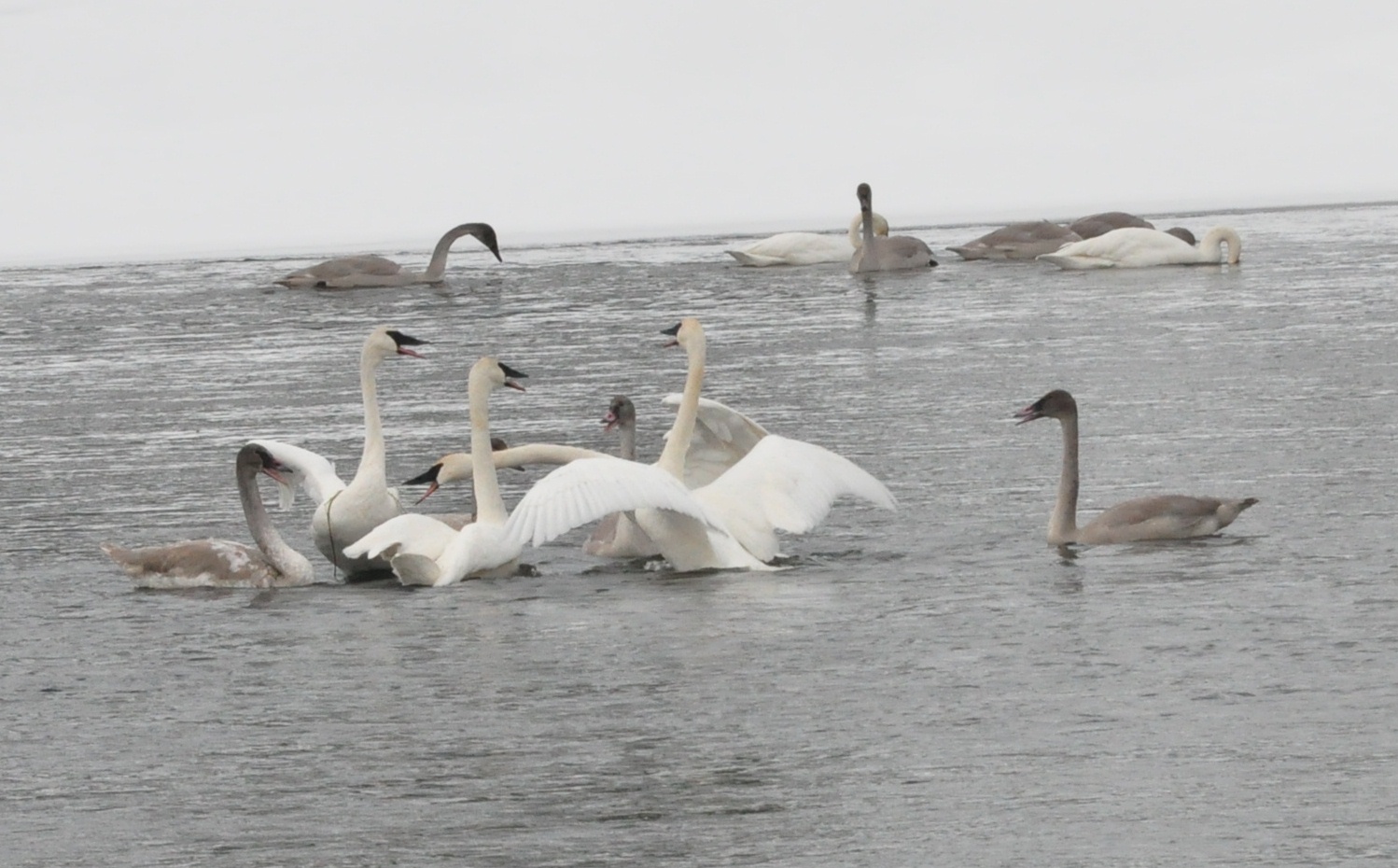
Trumpeter swans on the Henrys Fork

Yesterday while coming back from ice fishing Henrys Lake, the Henrys Fork of the Snake River was full on migrating trumpeter swans.  Here two adults (white ones) tend a flock of seven young ones.


Groups from two to nine continually drop in to join the 200 already on the water.


Here four come in for a landing.


Two pair of adults start arguing over the you five juveniles.  Reminded me of some divorced humans fighting for custody.


A lot of yelling, flapping of wings and raising all heck.


The fight finally increases coming to blows and bites while the kids start sounding off.


Other adults arrive to calm the situation as the two pair are separated.


A half hour was way too short to watch this great action movie, but it was a great way to spend a little time in the wilds of Idaho.

Thursday, May 6, 2010

SkyWatch Friday - Snow storm

May 6, and we woke up to snow on the ground - only about half a inch but it was snow.  I am ready for summer so next week I will be heading for Birmingham, Alabama, for six days.  Not for pleasure, but for work.

This evening after the snow had melted and it was still trying to spit on us, I got this picture of the sun trying to sneak through the clouds as it was setting.


The walk along the Henrys Fork of the Snake River was a great way to end another wild day in Idaho.

View other great pictures of the sky at http://skyley.blogspot.com/

Thursday, April 15, 2010

SkyWatch Friday - Sunset over the Henrys Fork

It has been a week of storms with four inches of snow on Tuesday.  Wednesday night the storm started to break and this was the sunset over the Henrys Fork of the Snake River.


A great view of the wildness of Idaho.

See other great sky pictures from around the world at http://skyley.blogspot.com/

Sunday, March 28, 2010

Geese for Friday, Fish for Saturday

Had a great two days in the Great Outdoors.  With only about a week to enjoy the snow goose migration, Friday evening I went back out to Camas NWR to visit.  The snow geese were in and out with a large flock flying around.


By evening, the geese were all out in the fields feeding but a small group.  But they wer joined by a lot of both Tundra and Trumpeter swan and flocks of ducks.


Then Saturday morning I headed to Henrys Lake to check on the spawning activity (see my fishing blog).  The sun was beautiful coming up over the east and creating a golden glow with all the fog.  Here the glow colors the Henrys Fork by Ponds Lodge.


At Henrys Lake the fish filled the run entering the spawn house.  This is a promise for a great fishing season for this year.


More wild days in Idaho for a guy who loves wildness.

Friday, January 1, 2010

SkyWatch Friday - Happy New Year

Happy 2010 - May it be a very happy and joyous one for you and your families.


Snow is falling as I write this, so I will be late going fishing today. Only a couple of days before I am back in school trying to inspire kids beyond what they think they can do.


We did get a break in the gray skies earlier in the week and I stole this picture of the sunset as the sun was setting over the Henrys Fork of the Snake River near St. Anthony, Idaho.

Just the end of another wild day in Idaho. Happy New Year.

Sunday, December 20, 2009

Henrys Fork

In a freezing rain I braved the roads to look for a few birds before I went with family to watch the "Nutcracker."  I did find a few birds braving the elements.  Geese, ducks, Trumpeter swan were all on the river with some of the Henrys Fork frozen over.  This swan had a blue neck collar.


My favorite sighting was a flock of about 100 Cedar waxwings with about 30 robins and starlings mixed in.


The "Nutcracker" was excellent.  I had several student in it as dancers and I loved trading some wildness for an afternoon watching it with two four-year old granddaughters.

Thursday, December 17, 2009

SkyWatch Friday - Sunset over South Fork of the Snake River

Between snow storms this week, I was able to capture the setting sun west of the Menan Buttes near the South Fork of the Snake River.


Just another wild evening of color in Idaho.
See more beautiful SkyWatch Friday photos.

Tuesday, December 15, 2009

Henrys Fork birds

Late this afternoon I ran up to the Henrys Fork between St. Anthony and the Vernon Bridge to see if I could see a few birds.  It was cloudy with some misty rain/snow falling most of the time so I did not think I would get any quality pictures.  But you never know what you will see or get a chance to photograph.  Here are a few of the highlights of the day.
A Blue Heron was available.


There were hundreds of Trumpeter swan, Canada Geese, and ducks.  Here are some swan and ducks resting on an ice flow.


I also saw 14 Bald eagles, seven of them sitting in some trees, but too far away for some good pictures.  But a few flew close enough for some shots.


Swan kept coming in to me until it was almost too dark to shot pictures.


But my favorite picture of the day was of a Red-tailed hawk that came into my preditor call and realized that I was just too large to harvest.


Just another couple of wild hours in Idaho.

Thursday, October 22, 2009

SkyWatch - Henrys Fork of the Snake River

SkyWatch FridayHere is the sunrise over the Henrys Fork of the Snake River near Macks Inn.  A beautiful, but very cold morning.  Only 10 degrees above zero.


Check out more beautiful pictures of the sky at SkyWatch Friday.

Wednesday, October 21, 2009

Cedar Waxwings

Recently the Cedar Waxwings have been getting in large groups and invading area towns.  The other day we had about 30 feeding on left-over chokecherry berries in my back yard.   Here is an article I recently wrote for a newspaper where it was printed.

Many wild animals have learned to adapt to urban environments. Coyotes live in Los Angeles sewers, kestrels and peregrine falcons nest on apartment ledges and ravens raid garbage cans throughout America’s cities.

Why not one of the most beautiful birds – the Cedar waxwing?

In the cities of southeastern Idaho put together several large fir trees with some berry producing bushes nearby and chances are the waxwings have staked out their homestead.

Hard to see and locate in the thick needles and leaves of mature trees, their soft call in the mid morning and early evening are hard to miss. Careful observation will locate these soft voiced, soft feathered beauties.

Their song is not melodic, but a distinctive buzzy, high-pitched trill. Once you learn to recognize this sound, you will hear it usually before you see the birds.

This year pairs of waxwings have nested in Rexburg and surrounding towns picking off ants and bees attracted to sap producing conifers. Cedar waxwings are late nesters, often waiting until berries as well as insects are available for the young.

Young waxwings are fed insects before they become berry eaters. Adults can be seen picking bees and other insects off leaves and pine needles and feeding them to their young.

They love to invade raspberry patches as well as currant and gooseberry bushes.


Waxwings get their name from small, red, wax-like appendages on the secondary feathers on their wings. A beautiful yellow band runs along the end of the tail and mask-like face sets off their striking tan plumage. In the eastern part of the United States, these birds have started feeding on an ornamental honeysuckle berry that turns the yellow band orange.

These birds are year around resident of Idaho where they feed on many different berries, flowers, and insects, with cedar and juniper fruit dominating their menu during the winter. During the winter of 2008-09, cedar waxwings were seen in large flocks along the Henrys Fork of the Snake River every month of the year. Wintering flocks invade the Russian Olive bushes at Market Lake and Mud Lake.

They are probably the most specialized fruit-eating bird in America. Because they often feed on fermented fruit, they become vulnerable to intoxication and death from eating rotting berries.

Fall is an excellent time to view these birds as they take full advantage of fruit trees and berry bushes loaded with fruit.

Waxwings are a social bird, sometimes congregating in groups of 100 or more. These groups will travel from place to place looking for a crop of fruit or berries and will feed until the berries are gone. While nesting, waxwings will pair up away from large groups only to become pare of a large social group after the young can fly long distances.

Residents of Rexburg, St. Anthony and Ashton do not have to travel further than their backyard to view these elegant birds. Crab apple trees and other fruit bearing trees bring these beautiful birds right to your window.

But cars parked under such trees get the “leftovers” created by these berry eating machines.
 

Sunday, October 18, 2009

Fishing Henrys Lake

Yesterday I fished Henrys Lake - for probably the last time this year - because it is starting to freeze.  I broke ice as I was leaving the dock so it was time to pull my boat out.  With 20 degree temperatures, my line would freeze in the guides, but the fish were coopertive and I had a great time for the three hours I was there.  I did not take my camera on the boat as it was too frosty and wet, but I got some wonderful pictures.

This one is of fog rising from the Henrys Fork of the Snake River as it comes from Harriman State Park just before the sun came up.


At Macks Inn, the sun still had not come up, but the lighting was much different because of the surrounding trees.


As I hit Henrys Lake Flat, the sun colored Sawtelle Mountain with a golden glow.


After talking to a few friends and getting the boat trailer attached to the truck, I got a picture of Mount Jefferson bathed in new snow from the northeast side.


As I was pulling my boat, a family of Buffleheads and some coots came to wish me good luck for the winter.

Tuesday, September 8, 2009

Answers to Questions from Comments

As I looked back over comments on my posts, I felt I should clearify a few things and answer some questions.
Some of you noticed that I did have pictures of my cute grandkids on some of my posts.  As a family we decided I would not post pictures of them for safety reasons.  On my article, "Where have all the fathers gone," I realize how important fathers and mothers are to children, especially girls.  I have four of them and our one-on-one time with me has been some of the most memorable times we have spent.  I attended every activity they were involved in while growing up.  I have also been invited into the delivery room of some of them - I declined - that is their husband's job!!!

A question about fly fishing lakes was brought up.  I have guided fly fishermen on lakes for 36 years and have fly fished them for 56 years.  We use a sinking fly line and fish within a foot of the bottom.  This is usually done in water less than 20 feet deep.
On the question, "Do I ever fish with bait?"  Yes, only when forced to.  Grandchildren need to fish and cannot fly fish.  The other time is when I ice fish.  I love to ice fish and use bait all winter long. 
I fish an average of twice each week.  My wife makes me!!!!!  We love to eat fish, but our favorite are the small kokanee salmon that I catch in the winter.  My wife will suggest we need some fish to eat many times during the winter.  That is what I call a magical woman!!!  We are blessed to live in an area where I can be fishing within five minutes of home.  Our home is located next to the Teton River and between the Henrys Fork and the South Fork of the Snake River.  So going fishing for an hour or two is not a large undertaking.  I do fish for "stocked" trout from time to time but prefer the wild ones.
On the question, "Is my header picture a grouse?"  Yes, it is a sage grouse.  Each spring I visit the leks (breeding grounds) of both Sage and Sharp-tailed grouse.  They dance, fight and breed.  Each year I take thousands of pictures of them.  The above picture is a sage grouse displaying for a female.
The above picture is of a Sharp-tailed grouse displaying on a lek to attract females.  Their showing off, dancing and strutting reminds me of men doing the same thing.  As with their human counterparts, the females chose their partners - and sometimes it will be different partners each day.
Have a great day.

Sunday, July 26, 2009

Osprey #1

I need to catch up on my blogs for this week. I have spent over six hours observing several osprey nests and their behavior. In the future I will write detailed article about ospreys, but for right now I will write about yesterdays observations of a nest I have been watching a photographing all year.
A week ago there were two chicks in the nest and now there is only one. It appears that three adults have joined forces to take care of this nest. A month ago I observed three adults building and maintaining the nest on the Henrys Fork of the Snake River near Ashton.
As I watched the nest, the female started calling and making a heck of a racket. Soon I saw two other osprey show up circling above the nest. They were beautiful to watch but then they too became very vocal.
Then I saw four cormorants flying up the river toward the nest. Even though cormorants are fish eaters, I have seen them eat ducklings and destroy nests of birds nesting near the water.
As the cormorants got closer, the two osprey circling the nest would take turns dive bombing them with one of the ospreys always staying between the cormorants and the nest. The female osprey stayed in the nest while the other two seemed to be protecting the nest from the cormorants.
The cormorants circled higher and higher with the osprey circling below them. Finally the four cormorants broke up with the osprey is hot pursuit of them.
What a show. I do not know if the cormorants posed any danger to the osprey nest, but it sure appeared to. After the cormorants left, the two osprey went back to searching for food on the Henrys Fork and I did not stay long enough to see if they brought food to the nest. I was late for work I had to get done.
There is just too much to observe and enjoy out there in the Wilds of Idaho and the rest of the world.